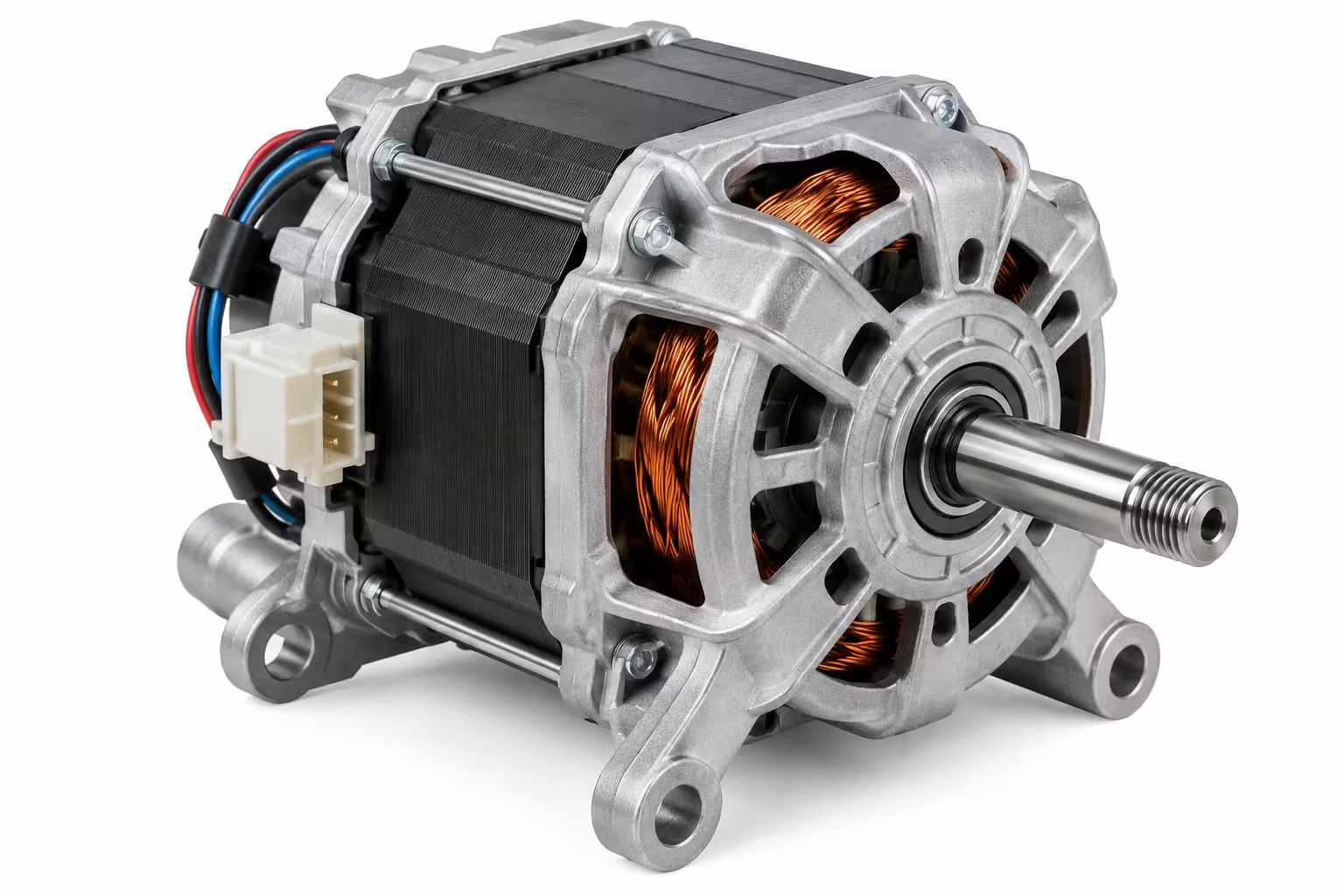
Motor
موتورDrives the drum rotation during wash and spin cycles. A failing motor causes weak agitation, no spin, or complete silence during the cycle.
Motor guideFrom motors, pumps and control boards to filters, door seals and inlet valves — we supply Suitable parts for LG, Samsung, Bosch, Daewoo, Toshiba, Beko, Whirlpool and every major brand, and install them on both the part and the labour.
Free inspection Calls answered 24/7 Independent repair service
Nine core parts, each with a real photo, its function in plain language, and a direct link to the full guide. Click the part you need — or scroll to the Symptom-to-Part table below if you're not sure yet.
Drives the drum rotation during wash and spin cycles. A failing motor causes weak agitation, no spin, or complete silence during the cycle.
Motor guide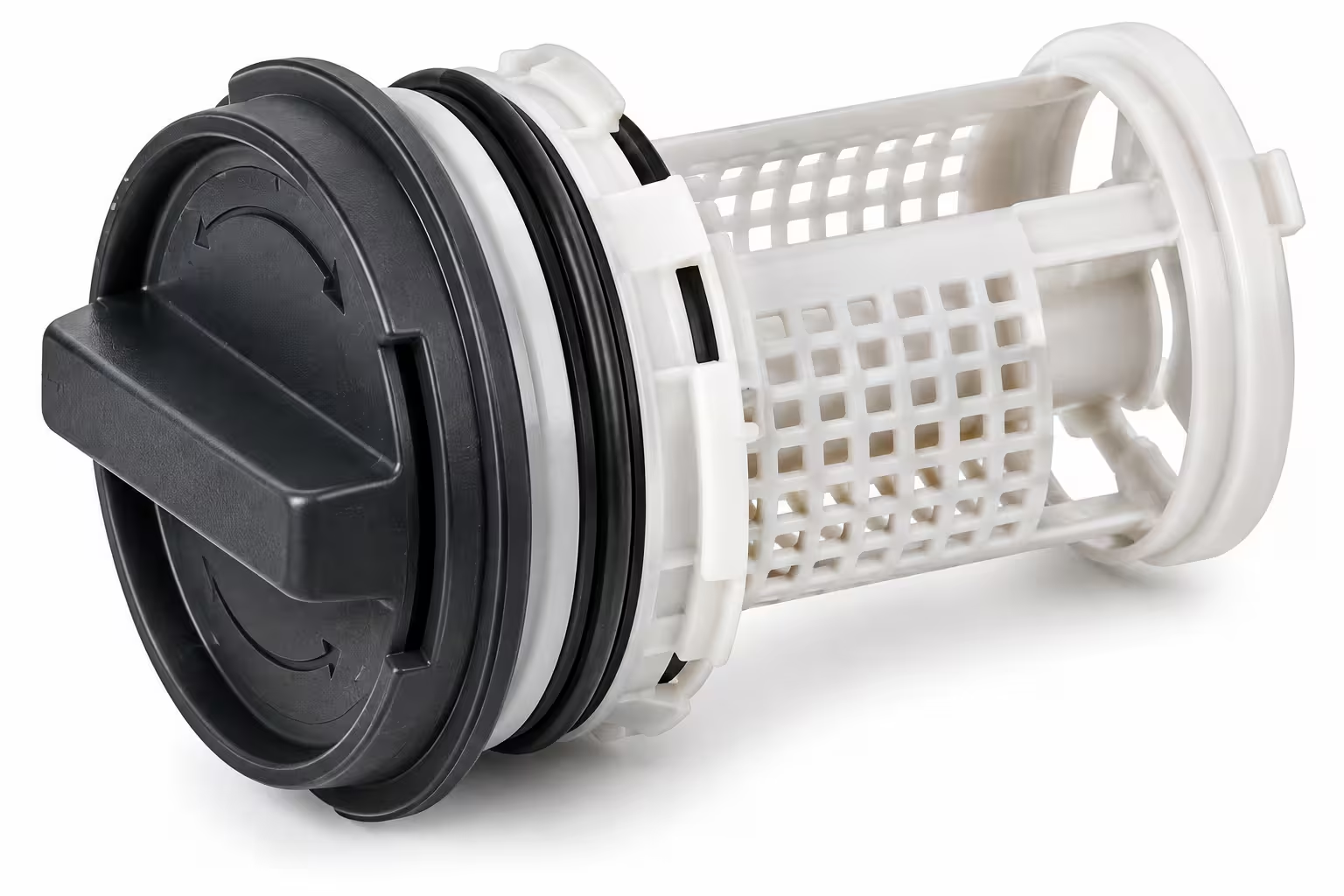
Traps lint, debris and foreign objects before they reach the pump. A clogged filter is the #1 cause of poor drainage and mid-cycle stops.
Filter guide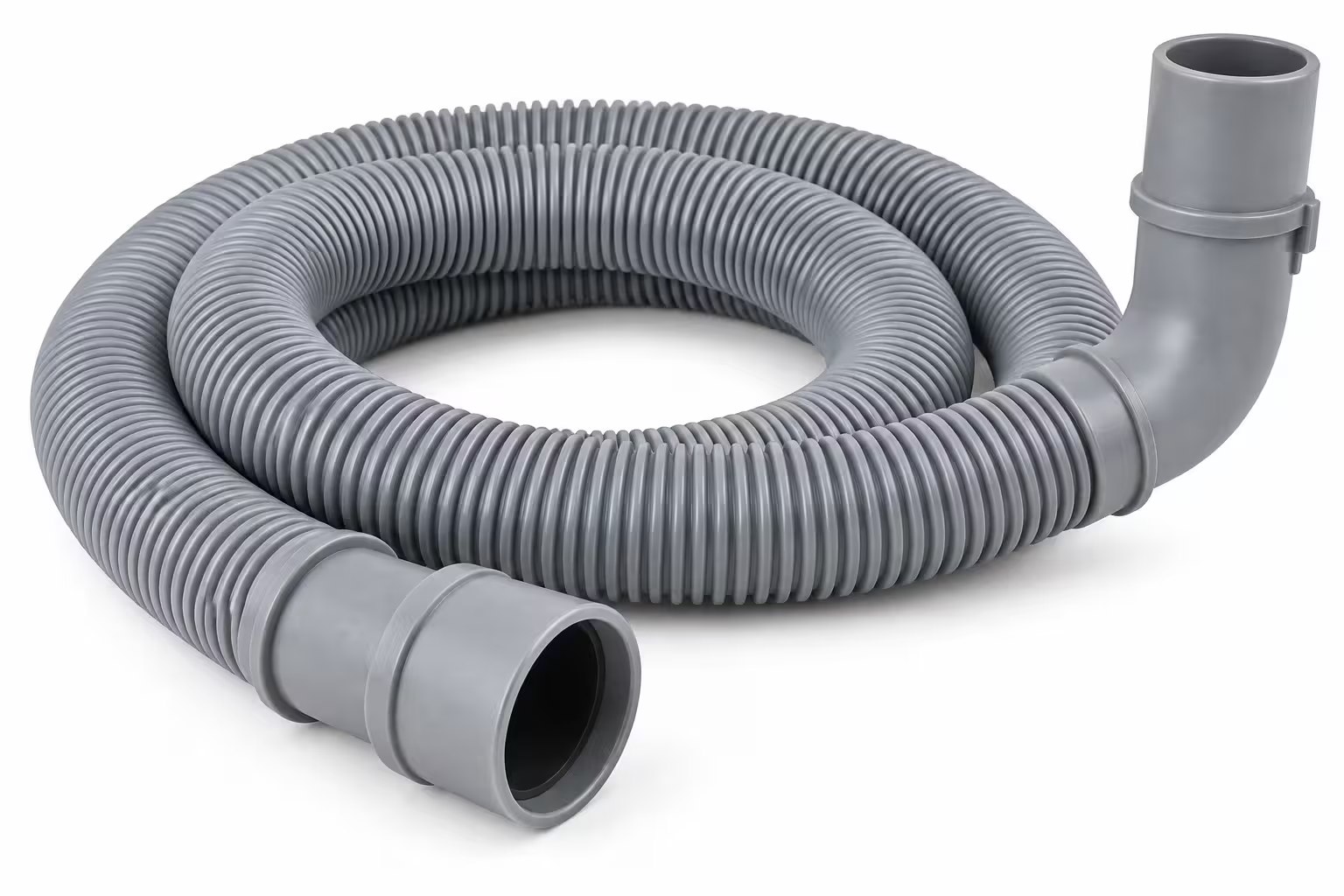
Carries used water from the drum to the household drain. A cracked or disconnected hose causes water on the floor during drain and spin.
Drain hose guide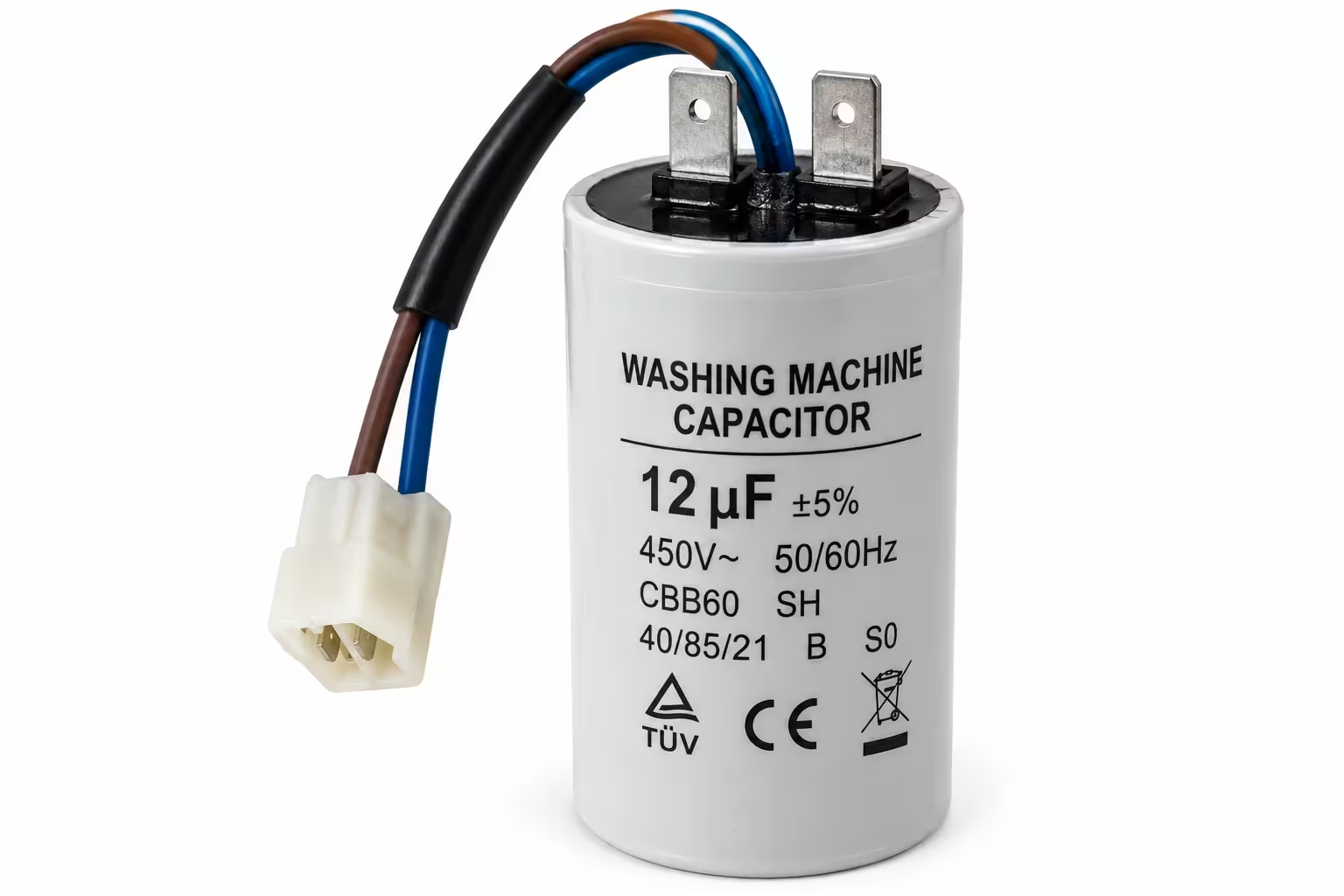
Provides the starting torque the motor needs to begin spinning. A weak capacitor is a common cause of "humming but not spinning".
Capacitor guide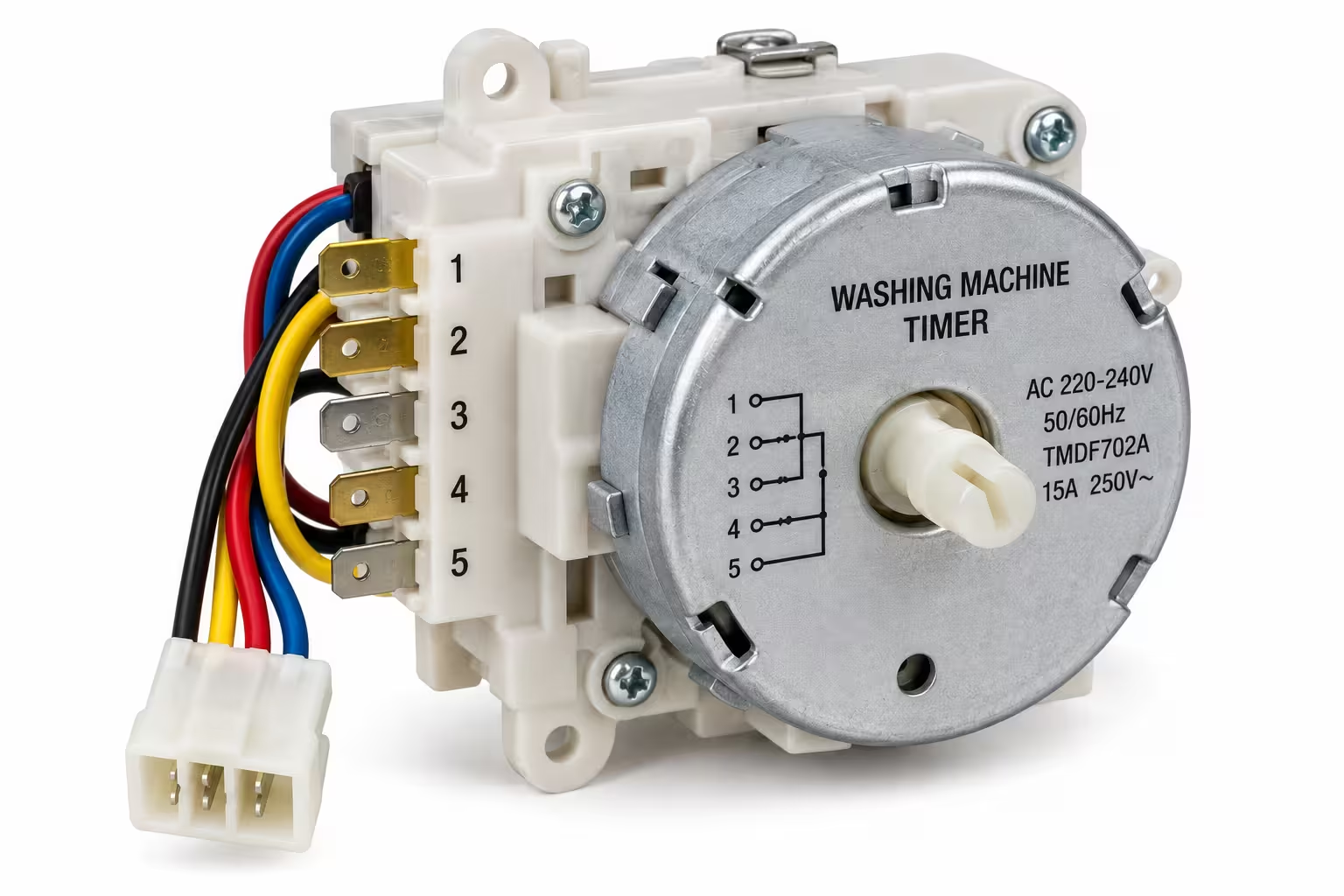
Controls the duration and sequence of each cycle stage on older models. Modern machines use electronic boards instead.
Timer guide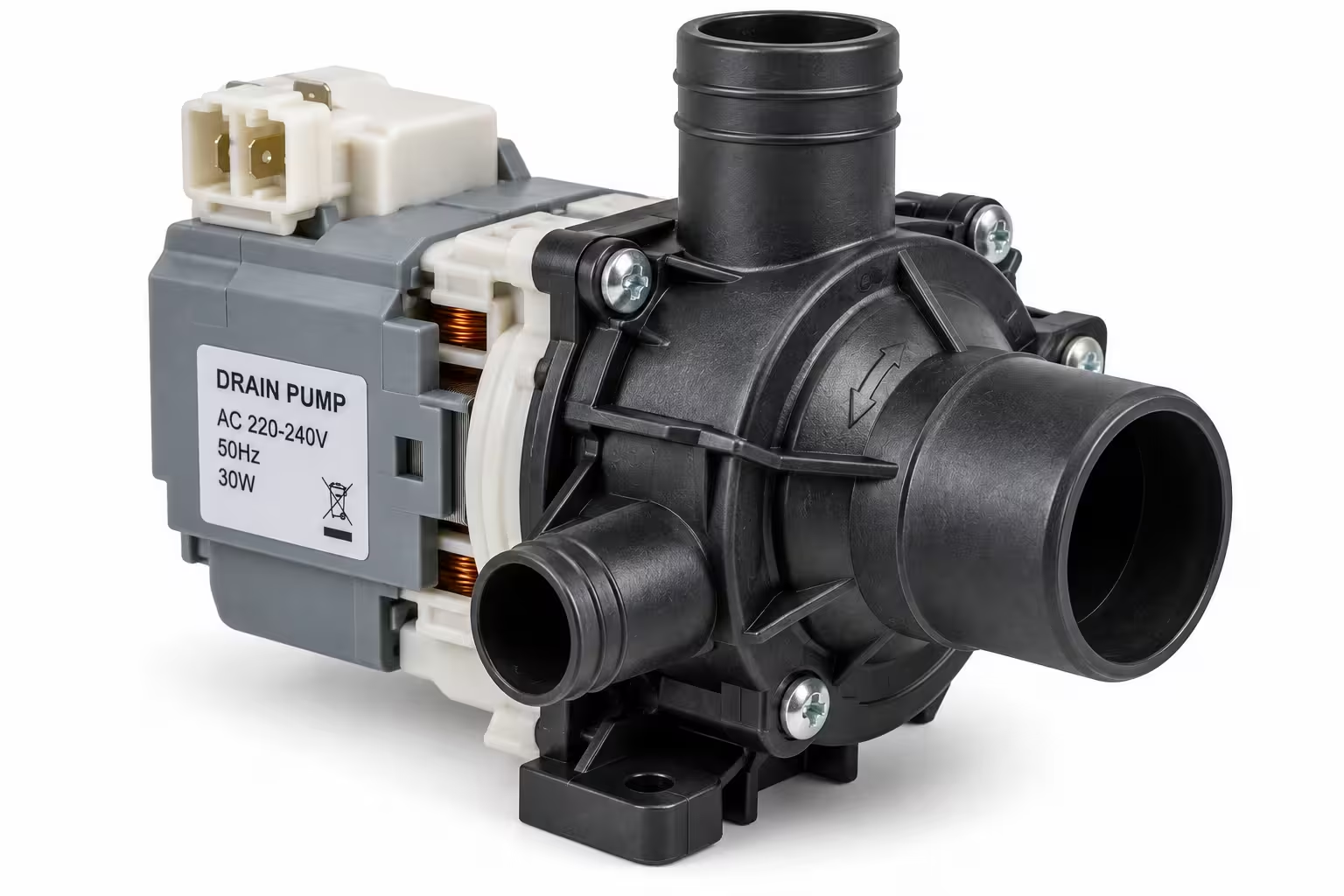
Actively pumps water out of the drum during the drain stage. A failed drain pump causes standing water, draining errors, and mid-cycle stoppages.
Drain pump guide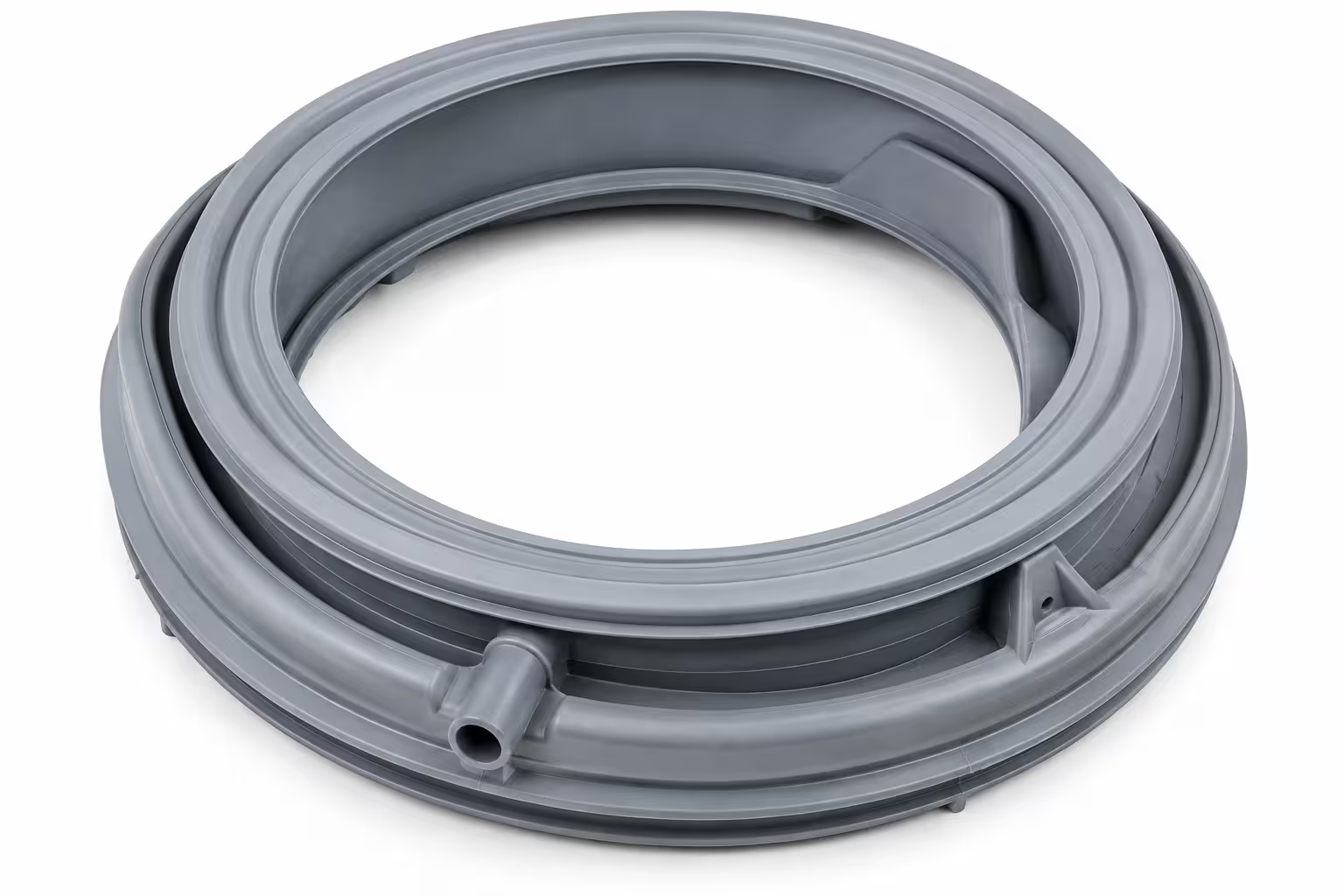
Watertight rubber gasket that seals the drum door on front-loaders. In coastal cities like Dammam, humidity accelerates mould damage.
Door seal guide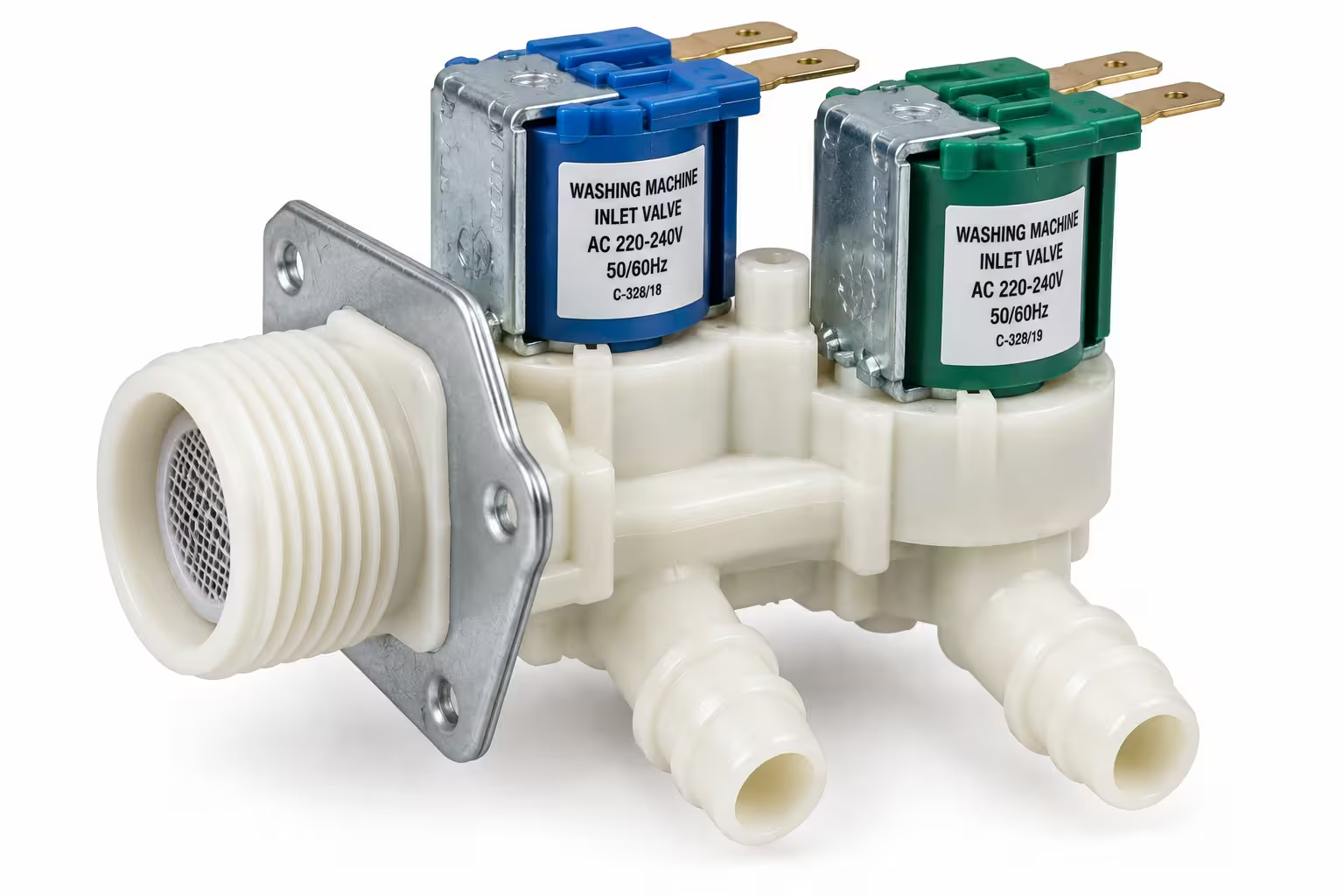
Opens and closes to control water entering the drum during fill. A stuck valve can cause continuous filling, overflow, or no water at all.
Inlet valve guide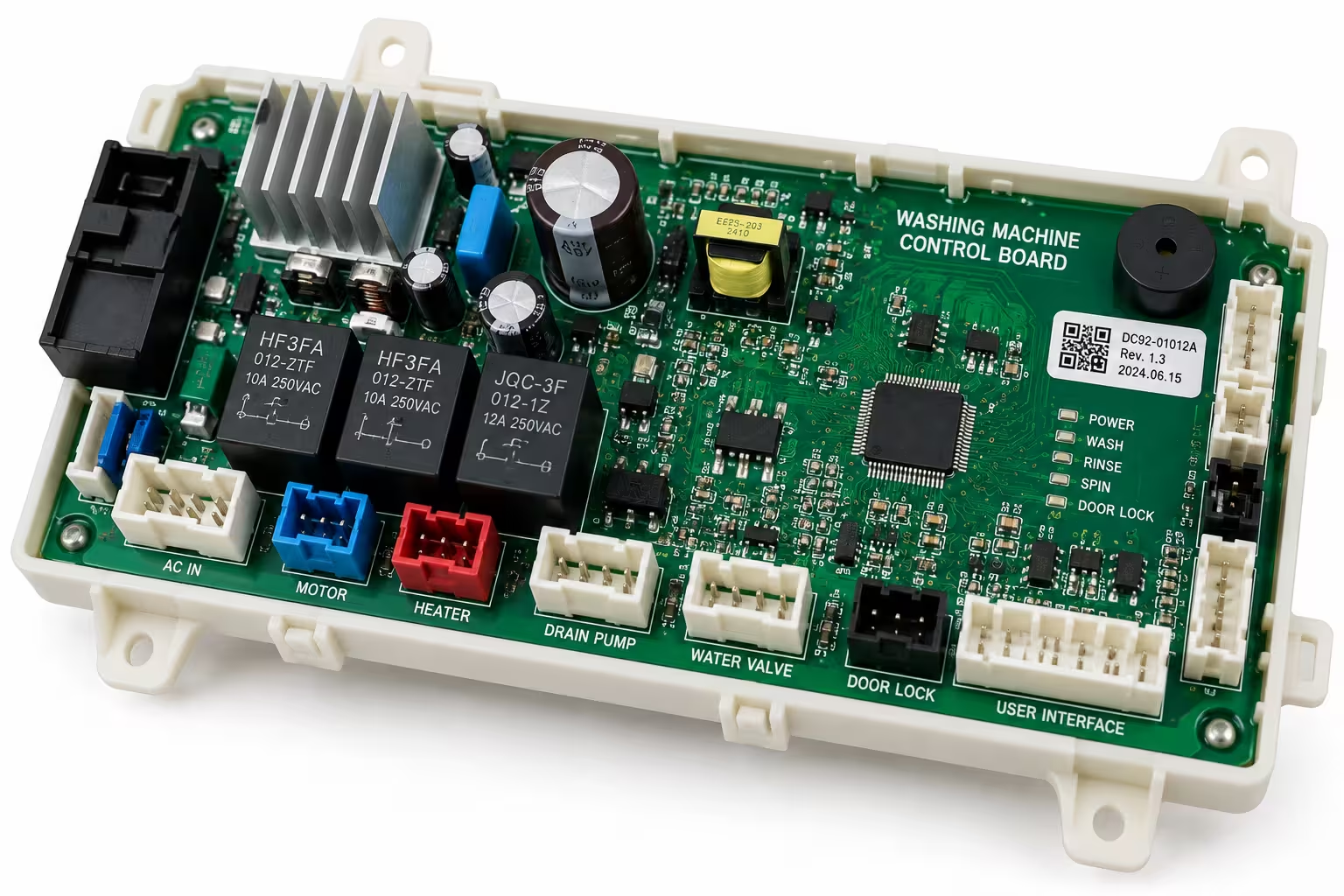
The electronic brain that manages the entire wash cycle. Must be correctly matched to your model number — never substitute a counterfeit board.
Control board guideSend us a photo of your washer's model plate and the problem (or the error code on the display) on WhatsApp. We'll identify the exact part and confirm the price — free of charge.
Most people don't know which part has failed — they only know what the washer is doing wrong. This table works in reverse: find your symptom, and we'll point you to the likely part.
| Symptom | Most Likely Part(s) | Confirm By |
|---|---|---|
| Washer won't drain, water sits in drum | Pump, Drain Hose, Filter | Check filter first; then listen for pump hum |
| Washer won't spin, drum doesn't rotate | Motor,Capacitor, Timer | Listen for motor hum without movement |
| Washer won't fill with water | Inlet Valve, Control Board | Check faucet and inlet filter mesh first |
| Washer overflows continuously | Inlet Valve (stuck open), Control Board | Shut off water; if it still fills, valve is stuck |
| Washer leaks from under the door | Door Seal | Inspect rubber gasket for tears or mould |
| Washer is completely dead, no lights | Control Board, Timer | Check outlet and breaker first |
| Washer makes grinding or roaring noise | Motor (bearings), Pump (debris) | Note when the noise occurs (wash vs. drain) |
| Washer stops mid-cycle with water in drum | Pump,Filter, Control Board | Check filter first; then error code |
| Washer leaves lint on clothes | Filter (clogged) | Remove and inspect filter |
| Washer fills slowly or not at all | Inlet Valve, Filter (mesh) | Clean mesh; check water pressure |
| Washer trips the breaker | Motor,Capacitor, Control Board | electrical hazard |
| Washer drum won't turn by hand | Motor, Control Board | Do not force the drum |
| Error code points to water supply | Inlet Valve | Check faucet, hose, mesh, then valve |
| Error code points to drainage | Pump, Drain Hose, Filter | Check filter, then hose, then pump |
| Error code points to motor or drive | Motor,Capacitor, Control Board | Note the code; consult part page |
| Water on floor during spin | Door Seal, Drain Hose | Inspect both |
Still not sure? See our full Washing Machine Problems guide — or call 0544006384 and we'll identify the part for you.
Each part below is broken down the same way: what it does, the signs it's failing, its lifespan, how Dammam, Al Khobar and Dhahran conditions affect it, replacement difficulty and typical SAR cost.
The motor is the heart of the washer. It drives the drum's rotation during both the wash agitation and the spin cycle. On modern machines it is either a traditional brushed motor or an inverter / direct-drive motor (LG Direct Drive, Bosch EcoSilence Drive, Samsung Digital Inverter).
The filter (also called the lint filter or drain filter) traps lint, coins, hair, and small foreign objects before they reach the drain pump. There are two types: the front-access drain filter (front-loaders) and the top-mounted lint filter (top-loaders). A clean filter is the simplest, cheapest way to prevent mid-cycle stops and drainage faults.
The drain hose carries used water from the drum to the household drain or standpipe. It connects the drain pump outlet to the household drain and is one of the most frequently replaced parts because it is exposed to heat, detergent residue, and physical movement during every cycle.
The timer controls the duration and sequence of each cycle stage on older (electromechanical) washing machines. It tells the washer when to fill, wash, drain, and spin. On modern machines, the timer has been replaced by the electronic control board — but many older Daewoo, Toshiba, and LG models in Saudi Arabia still use mechanical timers.
The drain pump actively pushes used water out of the drum and through the drain hose during the drain and spin stages. Without it, water sits in the drum and the cycle cannot progress. This is the single most commonly replaced part in Dammam, Al Khobar and Dhahran.
The door seal (also called the gasket or bellow) is the rubber ring that seals the drum door on front-loading washers. It is the #1 cause of front-door leaks — overloading, trapped laundry, and mould growth all contribute to its failure. Replacing a door seal is the single most common front-loader repair.
The inlet valve (or water inlet solenoid valve) opens and closes to control water entering the drum during the fill cycle. It's an electromagnetic valve controlled by the control board. When it fails, the washer either won't fill at all, or fills continuously and overflows.
The control board (also called the PCB, main board, or electronic control module) is the electronic brain that manages the entire wash cycle — fill, wash, drain, spin, and every sensor input in between. It must be matched exactly to your washer's model number. A wrong or counterfeit board can damage the motor, pump, and heating element.
Across Dammam, Al Khobar and Dhahran — particularly in informal parts markets — counterfeit and low-quality aftermarket washing machine parts are widely sold. They look almost identical to Suitable parts, they cost 30–60% less, and they are frequently fitted by technicians who either don't know or don't ask. The result is predictable: counterfeit parts fail within weeks or months, and in the worst cases they damage the very components they were meant to protect.
| Part | Risk of Counterfeit | Consequence |
|---|---|---|
| Control Board | Very High | Can fail within days; can send incorrect voltage to motor and pump, causing cascading failure |
| Inlet Valve | Very High | May not seal fully, causing slow overflow and water damage |
| Pump | High | Plastic impeller cracks under heat; limescale sticks faster to low-grade plastics |
| Capacitor | High | Can bulge, leak, or explode under load — genuine fire risk |
| Motor | Medium | Winding insulation fails early; can trip breakers |
| Door Seal | Medium | Rubber degrades rapidly; leaks within months |
| Timer | Medium | Contacts weld shut; cycle timing drifts |
| Filter | Low | Usually safe, but poor mesh quality reduces effectiveness |
| Drain Hose | Low | Usually safe, but low-grade rubber cracks with heat |
Before you accept a part from any supplier — including us — run these five checks.
Suitable parts arrive in branded packaging with a part number, barcode and country of origin. Counterfeit parts often arrive in plain plastic bags or unbranded boxes.
Every genuine part has an OEM part number stamped or printed on it. we'll do this with you.
Suitable parts are noticeably heavier and better finished. Counterfeit control boards have thinner PCBs; counterfeit valves have lighter solenoids; counterfeit motors have thinner windings.
full stop.
If a "genuine" part is priced 40% below the market rate, it is almost certainly counterfeit. Suitable parts have stable pricing across trusted suppliers.
Send us a photo of the part and its packaging on WhatsApp — and whether it's the right part for your model.
Every brand has its weak points. Here's what we see most often in Dammam, Al Khobar and Dhahran — and the brand-specific factor that causes it.
| Brand | Most Common Part Failures | Brand-Specific Note |
|---|---|---|
| LG | Control board, inlet valve, pump | Direct-drive motors rarely fail — the board and drain system are the weak points. LG error codes (OE, IE, FE) point directly to the part. |
| Samsung | Pump, control board, door seal | Balance sensors and boards are sensitive to voltage fluctuations — a surge protector is essential in Saudi Arabia. |
| Bosch | Door seal, pump, control board | Bosch parts are more expensive but last longer. Counterfeit Bosch boards are common in informal markets — insist on genuine. |
| Whirlpool / Maytag | Motor coupler, timer, pump | Direct-drive models have a motor coupler that fails more often than the motor itself — a cheap part that saves an expensive repair. |
| Daewoo | Pump, inlet valve, door seal | Extremely common in Saudi Arabia. Hard water destroys Daewoo pumps faster than any other brand — descale every 3 months. |
| Toshiba | Filter, pump, timer | Lint filters clog faster on Toshiba top-loaders; clean after every wash. |
| Beko | Door seal, inlet valve, control board | Beko seals degrade faster in coastal humidity — inspect annually in Dammam and Khobar. |
| Ariston | Door seal, pump, capacitor | Ariston capacitors fail more often than average — test before assuming the motor is dead. |
| Hitachi | Pump, inlet valve, door seal | Hitachi parts are less widely stocked; Suitable parts may need to be ordered — allow 2–3 days. |
| Midea | Control board, pump, filter | Midea boards are sensitive to voltage; use a stabiliser. |
| Panasonic | Pump, door seal, timer | Panasonic timers on older models fail more often than electronic boards. |
| Frigidaire | Pump, filter, door seal | Similar platform to Electrolux; parts are often interchangeable — confirm by part number. |
Don't see your brand? Call 0544006384 — we likely service it.
An honest breakdown — because pretending everything is easy helps no one.
With basic tools and a bit of care — these are genuinely DIY-friendly.
Doable for confident DIYers, but with real risk if you get it wrong.
Genuine electrical risk, expensive non-returnable parts, or both.
Even on a "DIY-friendly" part, the technician's value is in the diagnosis — not just the fitting.
Tell us your washer brand, model and the problem — or send us a photo on WhatsApp.
Start with the symptom, not the part. If the washer won't drain, the fault is almost always the pump, filter or drain hose. If it won't spin, it's usually the motor, capacitor or timer. If it won't fill, it's the inlet valve. Use our Symptom-to-Part table, or send us a photo of your washer's model plate and the error code on WhatsApp — we'll identify the part for you in minutes, free of charge.
Yes — especially for control boards, inlet valves, pumps and capacitors. Suitable parts last 2–3× longer than low-grade aftermarket equivalents, and they protect the components around them. A counterfeit control board can send incorrect voltage to the motor and pump, causing cascading failure that costs far more than the part itself.
Five checks: (1) Packaging — Suitable parts arrive in branded packaging with a part number, barcode and country of origin. (2) Part number — every genuine part has an OEM number stamped or printed on it. (3) Weight and finish — Suitable parts are noticeably heavier and better finished. (5) Price — if a "genuine" part is priced 40% below market rate, it is almost certainly counterfeit. See our full counterfeit guide.
Limescale-damaged pumps are the single most common part replacement in Dammam, Al Khobar and Dhahran because of hard water — descaling every 6 months significantly extends pump life.
Some parts are safe to replace yourself: the filter (5 minutes), drain hose (10 minutes) and door seal (30–45 minutes). Others carry genuine risk: capacitors can deliver a dangerous shock even when unplugged; control boards are expensive and non-returnable once fitted; motors require drum removal on most models. Up to 40% of parts replaced by DIYers are replaced unnecessarily. A technician diagnoses before replacing.
Yes, we can supply Suitable parts without installation, but we strongly recommend installation for anything other than filters and drain hoses. any damage caused by incorrect fitting is not covered.
Our technicians carry the most commonly replaced parts for LG, Samsung, Daewoo, Toshiba, Beko and Bosch washers in their vans — which means most repairs are completed on the first visit. For less common parts, we source from trusted suppliers in Dammam and typically have them within 24–48 hours.
In Dammam, Al Khobar and Dhahran, the drain pump is the single most common part failure — driven by limescale accumulation from hard water. After the pump, the most common failures are the door seal (front-loaders), inlet valve, control board and drain hose. In coastal cities like Dammam and Khobar, door seals also degrade faster because of humidity-driven mould growth.
Use the 8-year, 50% rule. especially on a premium brand like Bosch, LG or Samsung. After year 8, replace when the quote passes half the price of a new machine. Structural failures combined with age usually mean replacement is the wiser decision.
Yes — you paid for the part, so it's yours. We hand back the old part after every replacement. This is standard practice on every job.
We supply and install washing machine parts across Dammam, Al Khobar and Dhahran.Home visits by appointment is available in most districts of Dammam, Khobar and Dhahran when you call before 4 PM. Calls answered 24/7. Home visits Saturday–Thursday 8 AM–11 PM, Friday 2 PM–11 PM (Dammam time). See all service areas →